Business Casual vs Smart Casual: Key Differences Explained
Business casual and smart casual get used interchangeably so often that most people default to the same handful of outfits for both, then wonder why one setting feels overdressed and the other feels off. According to Gallup, 41% of U.S. workers already wear business casual most days, so getting the distinction right matters more than it used to.
The short version is that business casual is a workplace standard built around structure, while smart casual is a social standard built around polish. Here’s what actually separates them, piece by piece.
At a Glance: Business Casual vs Smart Casual
Before the details, here’s the short version side by side.
| Feature | Business Casual | Smart Casual |
|---|---|---|
| Setting | The office, workday meetings | Dinners, events, social gatherings |
| Bottoms | Dress pants, tailored trousers, structured skirts | Dark denim, chinos, tailored trousers |
| Tops | Collared shirts, blouses, structured knits | Camisoles, fitted tees, blouses |
| Outerwear | Structured blazer, often required | Relaxed blazer, optional but polished |
| Footwear | Loafers, low pumps, ankle boots | Loafers, block heels, clean sneakers in casual settings |
| Denim | Rarely appropriate | Dark wash denim is expected |
| Overall formality | More structured and consistent | More flexible, built around one polished piece |
What Business Casual Actually Means
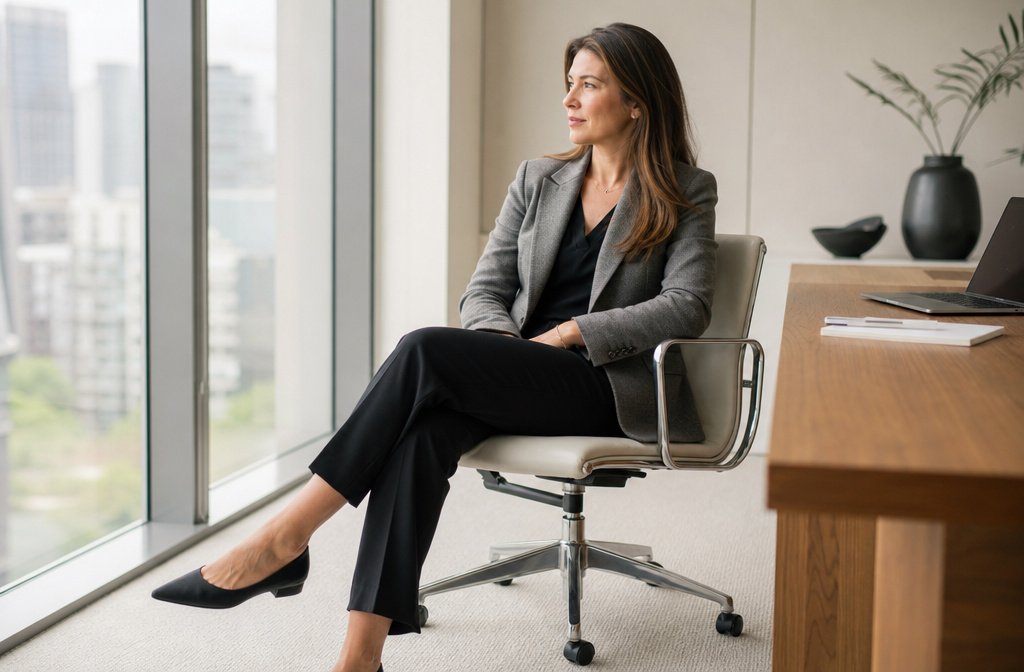
Business casual is a step down from a full suit, not a step down from professionalism. The goal is to look like you belong in a meeting without wearing a blazer and tie combination that feels overly formal for a regular workday.
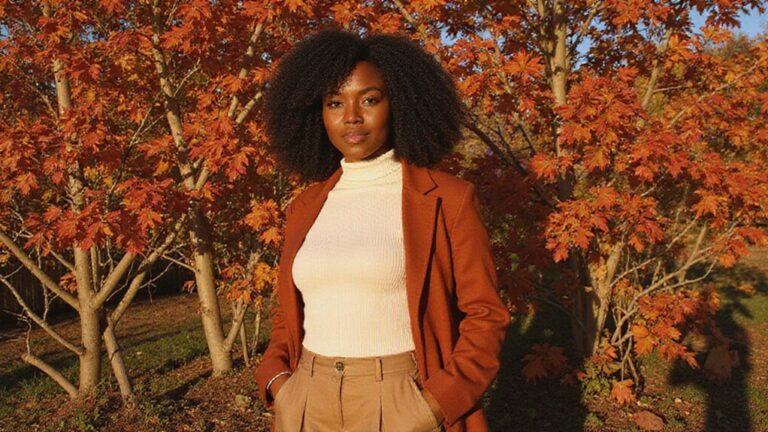
Bottoms should stay structured: dress pants, tailored trousers, or a knee-length skirt in a solid color, generally hitting at or just above the knee rather than shorter. Tops lean toward collared shirts, blouses, or fitted sweaters, ideally in solid colors or subtle patterns rather than anything busy.
A well-fitted blazer instantly signals business casual even over a simple top. Footwear stays polished and closed-toe in most offices, think loafers, low pumps, or ankle boots rather than sandals or sneakers. Heel height matters less than condition, scuffed shoes undercut an otherwise put-together outfit faster than almost anything else.
Jewelry stays minimal here too. A pair of stud earrings, a simple chain, or a classic watch looks intentional. Anything large or noisy pulls focus away from the professional impression the rest of the outfit is building.
What Smart Casual Actually Means
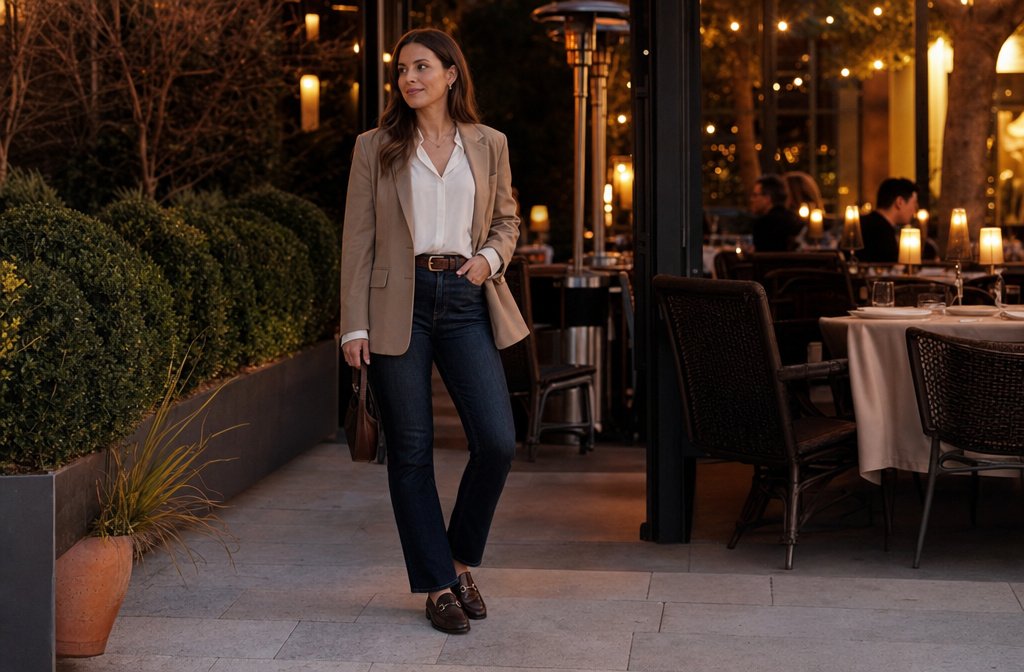
Smart casual works from the opposite direction. Instead of dressing down from a suit, you’re dressing up from jeans and a t-shirt, adding one or two polished elements that upgrade the whole look.
Dark wash denim is the anchor piece here, something that would look out of place in most business casual offices but comes across as intentional at a dinner or social event. Pair it with a silk camisole, a fitted blouse, or a simple tee, then add a blazer or structured jacket to pull the whole thing together.
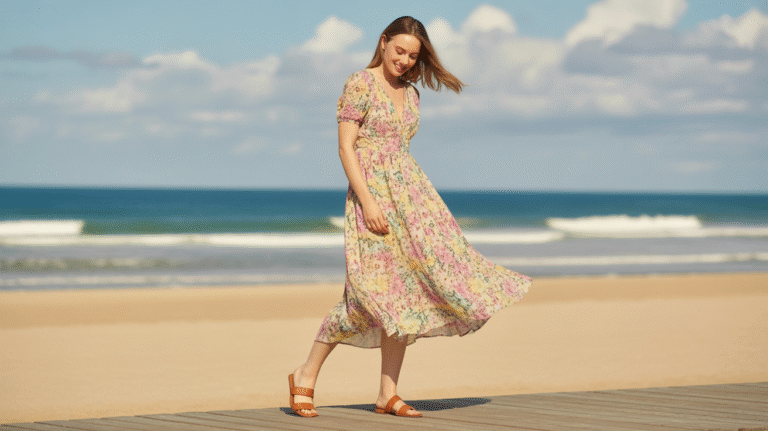
A midi dress or skirt with nice shoes and a structured bag works just as well. The formula stays the same regardless of the pieces: one relaxed element, one polished element, and nothing that looks like gym wear or loungewear.
Key Differences: Structure, Formality, and Occasion
Business casual is more structured and more consistent. The same handful of pieces work every day: tailored trousers, a blouse, a blazer, closed-toe shoes. There’s less room for personal style to override the professional standard.
Smart casual is more flexible and more personal. It flexes around the occasion, a rooftop dinner calls for something different than a daytime baby shower, even though both fall under the same dress code label. Personal style has more room to show here too, a signature accessory or an unexpected color choice comes across as intentional rather than out of place, which is exactly the kind of personal flourish business casual rarely leaves room for.
The clearest test: if the setting is a workplace with colleagues and clients, default to business casual. If the setting is social, an invite, a date, a gathering outside of work hours, smart casual is almost always the safer read. A useful backup question is who’s paying for the room, a client’s office, a restaurant, or a private event tends to signal which standard applies even when the invite doesn’t say.
Fabric and Color Choices That Signal Each Dress Code
Fabric does more work than most people give it credit for. A cotton-blend blouse and a silk camisole can be the exact same color and cut, yet one looks office-ready and the other looks evening-ready.
Business casual favors matte, structured fabrics: cotton, wool blends, and ponte knits that hold their shape through a full workday. Business casual palettes stay in neutral territory, navy, black, gray, camel, and white, with color used as an accent rather than the whole outfit.
Smart casual has more room for texture and shine. Silk, suede, and soft leather all look more refined without tipping into formalwear. Color can be bolder too, a jewel-toned top or a patterned skirt works for a dinner in a way it wouldn’t in most offices.
The one overlap worth remembering: dark, matte denim behaves like a neutral in both dress codes. It’s the rare piece that can anchor a business casual look in a relaxed office and a smart casual look everywhere else.
What to Avoid in Each
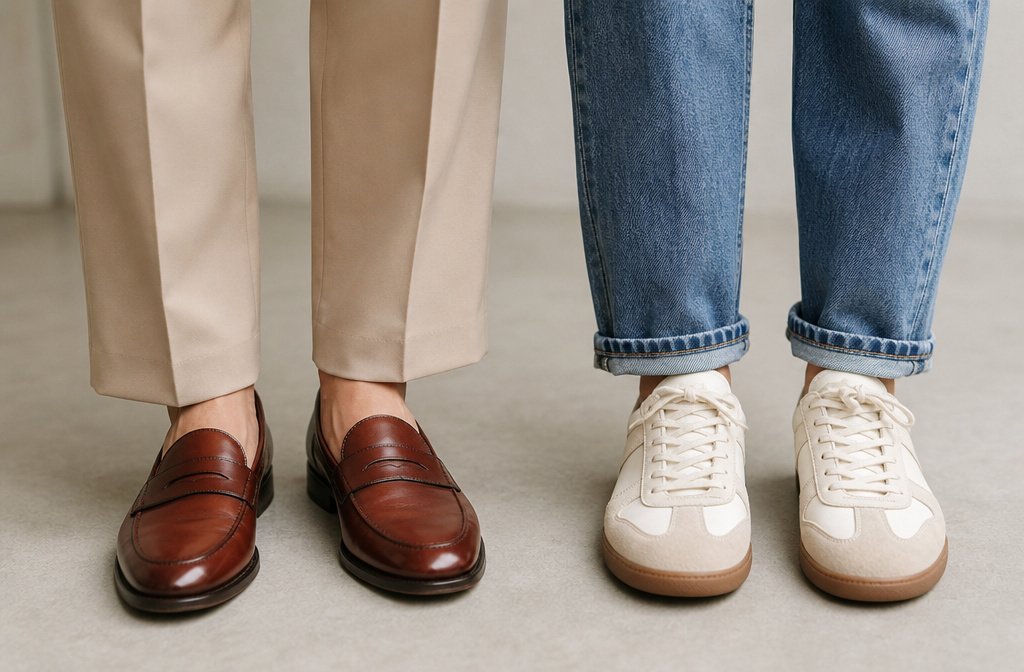
Both dress codes have their own failure points, and they’re rarely the same ones.
Skip This for Business Casual
- Ripped or distressed denim
- Graphic tees or hoodies
- Flip-flops or athletic sneakers
- Sequins, lace, or overly shiny fabric
- Anything sheer, backless, or off-shoulder
Skip This for Smart Casual
- Full gym or activewear, including leggings
- Wrinkled or visibly worn pieces
- Flip-flops or pool slides
- Ultra-high stilettos or glittery party heels
- Cargo pants or joggers
Quick Reference: What to Wear at a Glance
Here’s the short version, laid out so you can scan it before getting dressed.
Bottoms
Tops
Layers
Footwear
Accessories
Setting
Building Both Looks From the Same Closet
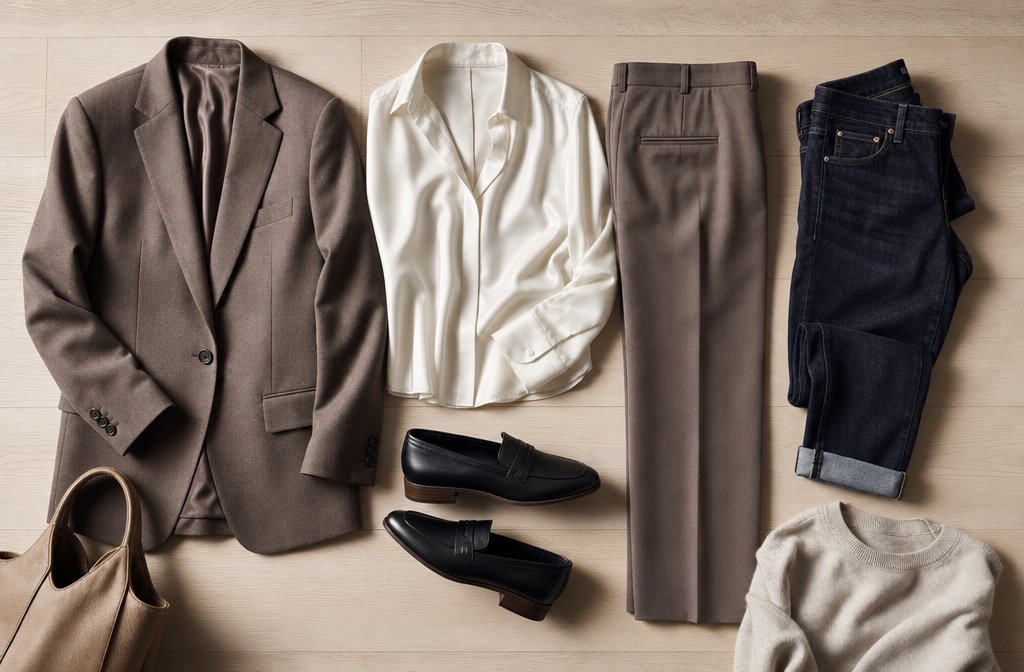
The good news is these two dress codes overlap more than they diverge. A well-tailored blazer, a pair of loafers, and a couple of neutral blouses work for both, just paired with different bottoms depending on the setting. A structured tote does double duty too, professional enough for the office, simple enough to carry to dinner straight from work without a second bag.
Trousers and a blazer take you through the workweek. Swap the trousers for dark denim and the same blazer instantly becomes smart casual for dinner after work. That kind of crossover is exactly what makes building a capsule wardrobe worth the upfront effort, fewer pieces end up covering more occasions.
If you already lean toward a polished, classic aesthetic, a lot of old money-inspired outfit ideas naturally sit right at the intersection of business casual and smart casual, which makes them a useful reference point for either dress code.
Seasonal Considerations
Both dress codes shift with the seasons more than people expect. In colder months, business casual leans on structured coats and knits, and these winter work outfit ideas show how to keep the silhouette professional without sacrificing warmth.
Smart casual has more room to play with texture in winter, think a cashmere sweater over tailored trousers, or a casual blazer styled over denim for something that still looks put-together without a full suit underneath.
Real-World Scenarios: Which One Fits
The dress code question usually comes up around a specific event, not in the abstract. Here’s how a handful of common ones actually sort.
| Scenario | Best Fit |
|---|---|
| First day at a new job | Business casual, until you see what coworkers actually wear |
| Client-facing meeting | Business casual, err on the more polished side |
| Casual Friday | Business casual, relaxed within the same structure |
| After-work happy hour | Smart casual, swap trousers for dark denim |
| Dinner date | Smart casual |
| Wedding guest, daytime | Smart casual, unless the invite specifies formal |
| Baby shower or bridal shower | Smart casual |
| Job interview | Business casual, slightly more formal than the role’s daily dress code |
When an invite says nothing at all, business casual is the safer overdress for work-adjacent events, and smart casual is the safer overdress for social ones. It’s easier to remove a blazer than to explain away an outfit that looks too casual.
Which One Should You Wear?
When the invite or dress code isn’t specific, this usually settles it.
Choose Business Casual If
- You’re at the office or in client-facing meetings
- The invite says “professional” or doesn’t specify
- You want the same outfit to work every day this week
- Colleagues or supervisors will be present
Choose Smart Casual If
- The event is social, a dinner, date, or gathering
- The invite says “smart casual” or “dressy casual”
- You want to wear denim without it looking underdressed
- The setting is outside of work hours entirely
Frequently Asked Questions
Can I wear jeans for business casual?
Rarely, and only in offices that explicitly allow it. Dark, well-fitted jeans paired with a blazer can pass in relaxed industries, but tailored trousers are the safer default in most workplaces.
Is smart casual the same as cocktail attire?
No. Cocktail attire is more formal and usually calls for a dress or tailored separates in dressier fabrics. Smart casual is a step below that, built around one polished piece rather than a fully formal outfit.
Are sneakers ever appropriate for either dress code?
Clean, minimal sneakers can work for smart casual in relaxed social settings, but they’re a risk in most business casual offices. When in doubt, loafers are the safer choice for both.
What’s the biggest mistake people make with these dress codes?
Treating them as interchangeable. Business casual leans structured and consistent, while smart casual flexes with the occasion, wearing one where the other is expected is the most common miss.
Does business casual look different across industries?
Yes. Finance and law tend to interpret it more formally, closer to a blazer and dress pants every day, while creative industries often stretch it to include dark denim or more relaxed knitwear.
How many pieces do I actually need to cover both dress codes?
Fewer than most people expect. One structured blazer, two pairs of trousers or dark denim, three tops in neutral colors, and one pair of loafers can cover the majority of business casual and smart casual situations. Add one dressier top and a pair of heeled sandals for evening events, and the same core wardrobe stretches across nearly every scenario in the table above.
What should I wear to a job interview?
Business casual, and slightly more polished than what the role’s daily dress code allows. A structured blazer over tailored trousers or a knee-length skirt looks prepared without overshooting into full formalwear.
Can a dress count as smart casual?
Yes. A knee-length or midi dress in a solid color or simple print works well for smart casual, especially paired with a structured bag and heeled sandals or block heels rather than anything too casual on the feet.
Is business casual different for men and women?
The underlying principle is the same, structured and polished without a full suit, but the specific pieces differ. Men typically default to a collared shirt and dress pants, while women have more flexibility across blouses, skirts, and tailored trousers. Indeed’s career advice guide breaks down the distinction in more detail if you want examples for a specific role.
Final Thoughts
Business casual and smart casual solve two different problems. One keeps a workplace looking consistent, the other keeps a social occasion looking intentional without tipping into black-tie territory. Neither is about following rules for their own sake, both are shorthand for reading a room correctly before you walk into it.
Start by building the handful of crossover pieces, a blazer, loafers, tailored trousers, and dark denim, then let the setting decide which combination you reach for. Once you know the difference, the guesswork disappears.